The Plants That Didn't Make It: On Grief, Failure, and What a Dead Garden Actually Teaches You
I killed a fiddle-leaf fig once. Okay, twice. The second time I really thought I'd figured it out.
I'd done the reading. I'd found the perfect spot — bright indirect light, away from drafts, near a humidifier I'd bought specifically for this plant. I watered carefully, checked the soil, talked to it a little (don't judge me). And then, over the course of about three weeks, it dropped every single leaf with an almost theatrical finality, like a diva exiting a stage.
I stood there looking at a bare stick in a pot and felt something that I can only describe as grief. Small grief, sure. Plant grief. But grief nonetheless.
If you've spent any real time with plants, you know this feeling. And yet we almost never talk about it.
Why We Bond With Plants in the First Place
The attachment we form with plants isn't irrational — it's biological, and it's ancient. Humans evolved in environments full of plants. Our nervous systems are calibrated to find green spaces calming. Research consistently shows that caring for plants reduces cortisol levels, lowers blood pressure, and activates the same nurturing neural pathways as caring for other living beings.
When you water a plant every day, when you notice new growth and rotate it toward the light and worry about it during a heat wave, you are in a relationship. A quiet, one-sided-ish relationship, but a relationship. The plant is alive. It responds to your care. And when it dies, something real is lost.
The psychology community has a term — "biophilia" — for our innate tendency to seek connection with other living systems. Plant parents aren't being dramatic when they mourn a dead plant. They're being human.
The Shame Spiral Is the Real Problem
Here's what I've noticed: the grief of losing a plant is usually followed almost immediately by shame. We blame ourselves. We catalog our mistakes. We wonder whether we're fundamentally bad at this, whether we should just give up, whether we should stick to fake plants like a sensible person.
This shame spiral is where the real damage happens. Not in the loss itself — in the story we tell ourselves about what the loss means.
Gardening culture, for all its warmth and community, has a complicated relationship with failure. Social media shows us the highlight reel: the thriving monstera, the abundant herb garden, the perfectly curated shelfie. What it doesn't show is the plant graveyard in the corner, the propagation attempts that went nowhere, the tomato plants that got blight in August.
The result is a distorted picture of what gardening actually looks like, which is: messy, unpredictable, full of death, and profoundly worthwhile anyway.
What Failed Gardens Actually Teach
I want to argue — and I mean this seriously — that the plants that don't make it are some of the best teachers you'll ever have.
Every dead plant is a data point. The fiddle-leaf fig that dropped its leaves taught me that I was probably overwatering and that my apartment gets draftier than I thought in winter. The basil that bolted in June taught me about the difference between growing herbs and harvesting herbs. The cactus that rotted in a pot with no drainage hole taught me a lesson I will never, ever forget about drainage holes.
These aren't failures. They're an education delivered in the language of living things.
Experienced gardeners — the ones with decades of dirt under their nails — will tell you this without hesitation. They've killed more plants than most of us have ever owned. They've had entire seasons go sideways. They've watched late frosts take out seedlings they'd been nurturing for weeks. And they're still here, still planting, because they learned to hold loss lightly.
That lightness isn't indifference. It's wisdom.
Imperfection as Practice
There's a concept in Japanese aesthetics called wabi-sabi — the beauty found in impermanence, imperfection, and incompleteness. A cracked pot. A lopsided branch. A garden that's a little ragged at the edges.
I think about this a lot in relation to gardening, and especially to plant loss. We're so conditioned to want our green spaces to look a certain way — lush, full, thriving, controlled — that we forget that all living things move through cycles of growth and decay. A garden that never dies is not a garden. It's a display.
Accepting imperfection in your garden is, genuinely, a mindfulness practice. It asks you to stay present with what's actually happening rather than what you wish were happening. It asks you to respond to your plants as they are, not as you want them to be. That's harder than it sounds, and more valuable than almost any specific gardening skill.
Making Peace With the Plant Graveyard
I have a small ceramic pot on my windowsill that I've designated as a kind of memorial for plants that didn't make it. It holds a few dried seed pods, a piece of bark from a tree I loved, a pressed leaf from that second fiddle-leaf fig. It's a little morbid, maybe. It's also a reminder that loss is part of this, and that's okay.
Some practical things that have helped me move through plant loss without getting stuck in shame:
Autopsy without judgment. Try to figure out what happened, not to punish yourself, but to learn. Was it watering? Light? Soil? Pests? Sometimes you'll never know, and that's okay too.
Give yourself a minute. It's fine to feel bad about it. Don't rush past the feeling into "it's just a plant." It was your plant, and you cared about it.
Try again, or try something different. Maybe you'll give the fiddle-leaf fig another shot with new knowledge. Maybe you'll decide that plant and your lifestyle are not compatible, and you'll find something better suited to your actual conditions. Both are valid.
Talk about it. The plant community is full of people who have killed things they loved. Sharing failure normalizes it, and normalization is how we break the shame cycle.
Roots in the Ruins
Here's what I've come to believe after years of growing things and losing things: a garden that's never failed you hasn't really taught you anything yet.
The brown leaves, the root rot, the seeds that never germinated — these are the moments when gardening stops being a hobby and starts being a practice. A practice of patience, of observation, of sitting with outcomes you didn't choose and finding what grows in the space they leave behind.
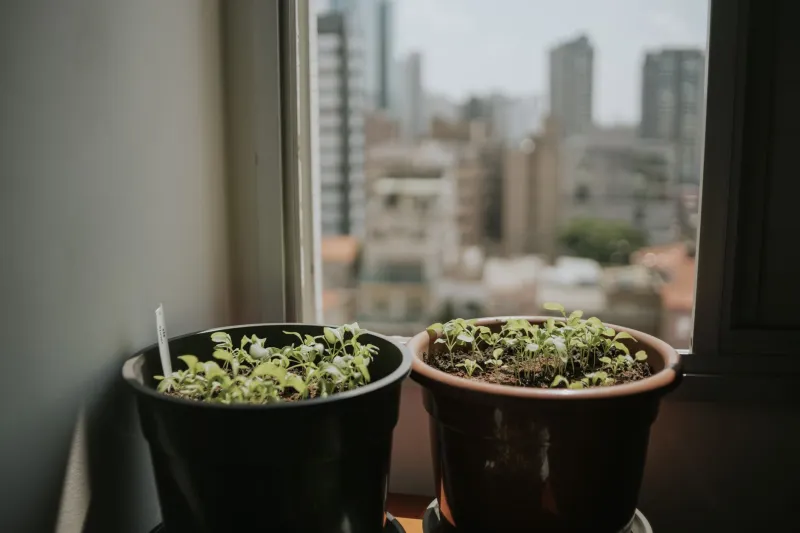
That second fiddle-leaf fig left behind a beautiful empty spot on my windowsill that now holds three small pothos cuttings I propagated from a cutting a friend gave me. They're thriving. They're easy. They don't care about drafts.
I like them a lot. But honestly? I learned more from that bare stick in a pot.
The plants that don't make it are still part of your garden story. Let them count for something.